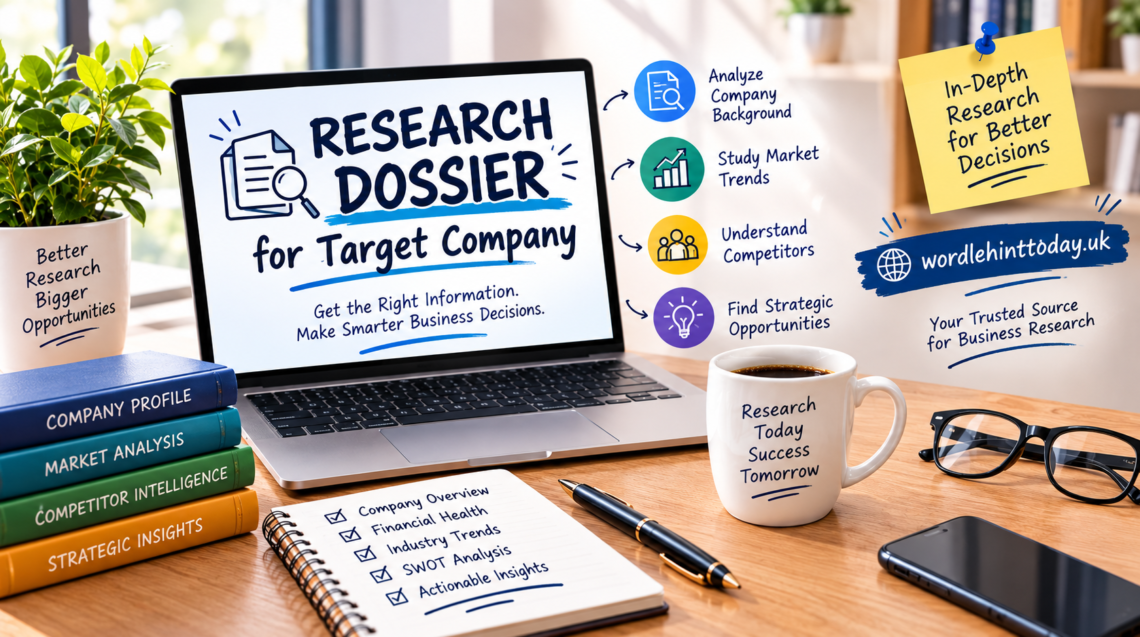
A research dossier for target company is a structured document that brings together important information about a business in one place. It helps professionals understand a company’s background, operations, financial position, market presence, competitors, and potential risks. Whether someone is preparing for a business partnership, investment decision, sales meeting, or acquisition, a well-organized research dossier can make the process easier and more effective.
Business decisions often require more than a quick internet search. Companies need reliable information to understand opportunities, identify challenges, and evaluate whether a potential business relationship makes sense. A detailed company research dossier provides a practical starting point by organizing relevant findings into a clear and useful format.
What Is a Research Dossier for Target Company?
A research dossier for target company is a comprehensive business profile created to support research, planning, and decision-making. It combines relevant information from different sources into one organized document. The goal is to give readers a clear understanding of the company without requiring them to search through multiple websites and reports.
The dossier may include company ownership, leadership, products, services, financial information, industry position, competitors, and recent developments. Its exact contents depend on why the research is being conducted. For example, a sales team may focus on customer needs and purchasing priorities, while an investor may pay greater attention to financial performance and business risks.
Unlike a short company overview, a research dossier usually goes beyond basic facts. It explains why certain information matters and how different findings relate to one another. This makes it a valuable resource for professionals who need a deeper understanding of a potential customer, supplier, partner, competitor, or investment opportunity.
Why Is a Target Company Research Dossier Important?
A well-prepared dossier helps businesses make decisions based on evidence rather than assumptions. Before approaching a company, professionals can use the research to understand its business model, priorities, challenges, and position within its industry. This preparation can lead to more relevant conversations and better planning.
Another important benefit is risk identification. A company may appear attractive at first, but further research could reveal concerns involving financial stability, legal disputes, regulatory compliance, reputation, or market competition. Identifying these issues early allows decision-makers to investigate further before making commitments.
A research dossier also saves time by bringing essential findings together in one place. Team members can review the same information instead of repeating the same research independently. When the document includes clear sources, dates, and explanations, it becomes easier to verify information, update findings, and communicate conclusions across departments.
Key Information to Include in a Company Research Dossier
The quality of a research dossier depends on the relevance and accuracy of its contents. A useful document should cover the areas that directly support the intended business decision.
Start with the company’s basic profile. Include its official name, website, headquarters, industry, founding date when verified, main products or services, and operating locations where publicly available. This information establishes the company’s identity and provides context for the rest of the research.
Next, examine the company’s ownership and research dossier for target company leadership. Identify publicly disclosed executives, founders, parent companies, subsidiaries, and other relevant organizational relationships. Use official company pages, regulatory filings, and other credible sources to verify these details. Avoid treating outdated profiles or unconfirmed online claims as established facts.
The dossier should also describe the company’s business model and target market. Explain how it generates revenue, who its customers are, what problems its products solve, and which industries it serves. Include relevant information about its distribution channels, business partnerships, and product positioning when reliable evidence is available.
Finally, add financial, competitive, and operational information where appropriate. Public companies may provide annual reports and audited financial statements, while private businesses may disclose much less. Clearly distinguish reported figures from estimates and avoid presenting unavailable information as fact.
How to Conduct Research for a Target Company
Effective company research begins with a clear objective. Before collecting information, determine what the dossier needs to help you decide. Research for a potential supplier, for example, may prioritize operational reliability and product quality, while research for a possible acquisition may require deeper financial, legal, and commercial analysis.
Once the objective is established, identify research dossier for target company reliable sources. Useful sources include the company’s official website, annual reports, government business registries, securities filings, reputable news publications, industry associations, and relevant market reports. Professional networking platforms may help identify publicly listed leadership and organizational relationships, but their information should be checked against stronger sources when possible.
After collecting the information, compare findings across sources. Check whether company names, leadership details, financial figures, and reported events are consistent. Pay attention to publication dates because business information can change quickly. If sources disagree, document the difference rather than selecting the version that best supports an existing assumption.
The final step is to organize the findings into a readable report. Separate verified facts from analysis, label estimates clearly, and explain any important limitations. A useful dossier should help readers understand both what the evidence shows and what remains uncertain.
Analyzing the Target Company’s Market and Competitors
Understanding a company’s market position research dossier for target company is an essential part of a research dossier. A business does not operate independently of its industry. Customer expectations, changing technology, economic conditions, regulations, and competitor activity can all influence its performance.
Begin by identifying the company’s main competitors. These may include businesses offering similar products, alternative solutions, or services that address the same customer needs. Compare relevant factors such as product range, pricing approach, geographical reach, customer segments, distribution methods, and publicly available customer feedback.
Next, examine the company’s apparent strengths and weaknesses. Strengths might include a specialized product, an established brand, strong distribution, or a clearly differentiated service. Potential weaknesses could involve limited market coverage, dependence on a small number of products, or gaps in publicly documented capabilities. These observations should be supported by evidence wherever possible.
Market analysis should also consider future opportunities and threats. Changes in customer behavior, emerging technologies, new regulations, and competitor expansion may create important developments. However, distinguish current evidence from predictions. A balanced analysis explains what is research dossier for target company known, what may happen, and what additional research would be needed to reach a stronger conclusion.
Assessing Financial Performance and Business Risks
Financial analysis can help determine whether a target company appears commercially stable and suitable for a proposed business relationship. For publicly listed companies, annual reports, financial statements, and regulatory disclosures are often the most useful starting points.
Relevant indicators may include revenue, profitability, cash flow, debt, operating expenses, and changes in performance over time. Looking at several reporting periods can reveal patterns that a single year’s figures may hide. Comparisons with industry peers can provide additional context, although differences in company size, business models, and accounting methods should be considered.
Not every company publishes detailed financial information. Private businesses may provide limited disclosures, so the dossier should state when reliable financial data is unavailable. Estimates from third-party websites should not be treated as equivalent to audited accounts, and unexplained figures should never be presented as confirmed results.
Risk analysis should extend beyond finances. Depending on the purpose of the research, relevant concerns may include regulatory obligations, litigation, cybersecurity, supply chain dependence, reputation, customer concentration, and changes in leadership. A dossier should identify documented risks, research dossier for target company explain their possible business implications, and recommend further verification when the available evidence is incomplete.
Using a Research Dossier for Business Decisions
A research dossier becomes most valuable when its findings support a specific action. Sales teams can use it to understand a prospect’s products, business priorities, and likely challenges. This preparation helps them develop relevant proposals rather than relying on generic sales messages.
Procurement teams can use company research to evaluate potential suppliers. Information about business history, operating locations, product capabilities, financial disclosures, and publicly documented compliance issues may help determine whether further supplier checks are necessary. A dossier can support this process, but it should not replace formal due diligence or contractual safeguards.
Investors, consultants, and business research dossier for target company development teams may use a dossier to assess strategic opportunities. It can help identify potential partnerships, market gaps, competitive advantages, and questions that need answers before negotiations begin. For mergers, acquisitions, or other high-value transactions, the initial research should lead to more detailed financial, legal, tax, and operational reviews.
The findings should be presented with a clear distinction between evidence and recommendations. For instance, a report may confirm that a company has expanded into a new market, but whether that expansion creates an attractive partnership opportunity requires additional analysis. Keeping facts and interpretations separate makes the document more credible and useful.
Best Practices for Creating and Maintaining a Reliable Dossier
A reliable research dossier should be accurate, research dossier for target company relevant, easy to navigate, and regularly updated. Begin with a consistent structure that allows readers to find key information quickly. Common sections include the executive summary, company profile, leadership, products and services, financial overview, market analysis, risk assessment, and recommended next steps.
Source management is equally important. Record where each important claim came from and when the information was accessed or published. Prefer primary sources for official company details and financial disclosures, while using reputable secondary sources to provide context. When information cannot be verified, label it accordingly instead of presenting it as certain.
Confidentiality and ethical research practices should guide the process. Focus on legitimate business information that is relevant to the research objective. Respect applicable privacy laws, data protection requirements, website terms, and restrictions on confidential or proprietary information. Avoid collecting unnecessary personal details about employees, executives, or other individuals.
Finally, review the dossier whenever new information becomes available or the business decision changes. Leadership, ownership, financial results, and market conditions can become outdated. A clear review date and an update schedule help users understand how current the information is. For important decisions, assign responsibility for checking significant findings before the report is relied upon.
Conclusion
A research dossier for target company is a practical tool for understanding a business before making an important decision. By bringing together company information, leadership details, financial findings, market analysis, competitive insights, and potential risks, it provides a structured view of the target organization.
The strongest dossiers rely on credible sources, distinguish verified facts from assumptions, and focus on information that supports a clear objective. They also acknowledge uncertainty instead of filling gaps with unsupported claims. Whether used for sales prospecting, supplier evaluation, investment research, or strategic partnerships, a carefully prepared company research dossier can improve preparation and help professionals ask better questions.
Ultimately, the value of the dossier depends not on how much information it contains, but on how accurately that information explains the company and supports the decision at hand.
Do you like this personality?