Introduction
Artificial intelligence is changing how businesses operate, serve customers, and make decisions. Companies are increasingly exploring AI tools to automate routine work, analyze information, improve productivity, and stay competitive. In this changing environment, the keyword droven.io AI in digital transformation has attracted interest from readers looking to understand the connection between AI, digital innovation, and modern business strategies.
However, understanding a specific platform requires more than knowing what artificial intelligence can do. Readers also need to understand its potential applications, practical benefits, limitations, and reliability. Without verified information about a particular website or service, it is important to separate general AI capabilities from claims about the platform itself.
This article explores the meaning of Droven.io AI in digital transformation, how AI supports business modernization, which technologies matter most, and what organizations should consider before adopting AI solutions. It also explains the challenges businesses may encounter and answers common questions for readers researching this topic.
Table of Contents
- What Droven.io AI in Digital Transformation Means
- Why Businesses Are Exploring AI
- Key Technologies Behind AI-Driven Transformation
- Practical Applications of AI in Business
- Benefits of AI-Powered Digital Transformation
- Challenges and Risks to Consider
- How to Evaluate an AI Platform
- Frequently Asked Questions
- Conclusion
What Droven.io AI in Digital Transformation Means
The phrase droven. io ai in digital transformation brings together a website or platform name, artificial intelligence, and the process of modernizing business operations through technology. People searching for this term may want to learn about the platform, explore AI-related business information, or discover how artificial intelligence can help organizations adapt to digital change.
Digital transformation involves more than purchasing new software. It means improving how an organization works by using digital technologies, updating outdated processes, and creating better experiences for customers and employees. Artificial intelligence can support this process by helping businesses analyze data, automate repetitive tasks, and generate useful insights.
It is important to clarify that these general capabilities do not confirm which services Droven.io provides. Without independently verified information about its current website, features, ownership, and services, specific platform claims should not be treated as established facts. Readers should examine the actual website and its published documentation before deciding what the platform offers.
Understanding AI in Digital Transformation
AI refers to computer systems designed to perform tasks that commonly require human intelligence. These tasks may include recognizing patterns, processing language, making predictions, and generating content. The exact capabilities depend on the technology, available data, and how the system is configured.
Digital transformation uses technologies such as cloud computing, data analytics, automation, and AI to improve business processes. For example, a company might use AI to classify customer support requests while its cloud platform stores the information and makes it accessible to authorized employees.
The main objective is to solve real business problems. AI is most useful when it supports a clear goal, such as reducing manual work, improving response times, or helping employees make better-informed decisions.
Why Businesses Are Exploring AI
Businesses are exploring artificial intelligence because traditional processes can be slow, expensive, and difficult to scale. Employees may spend hours organizing information, responding to similar questions, preparing reports, or moving data between systems. Carefully selected AI tools can reduce some of this repetitive work.
Another reason is the growing importance of timely information. Companies collect data from websites, customer interactions, sales platforms, inventory systems, and other sources. AI-powered analytics can help identify patterns in this information, allowing teams to investigate problems and recognize opportunities more efficiently.
Competition also encourages organizations to review their technology. Businesses that improve internal workflows may be able to respond to customers faster and adapt more easily to changing demands. However, adopting AI simply because competitors are doing so is rarely a sound strategy. Every investment should address a defined need and deliver measurable value.
Changing Customer Expectations
Customers increasingly expect convenient digital services, clear communication, and quick answers. AI-powered assistants can help businesses provide basic support outside normal working hours, answer common questions, and direct complicated requests to the appropriate team.
Personalization is another potential application. AI systems can analyze permitted customer data to identify preferences and recommend relevant products or services. Businesses must use this capability responsibly, respecting privacy requirements and avoiding intrusive practices.
Human support remains important, particularly when customers face complicated problems or need to discuss sensitive information. A successful digital transformation combines useful automation with accessible human assistance rather than trying to remove people from every interaction.
Key Technologies Behind AI-Driven Transformation
AI-powered digital transformation depends on several technologies working together. Understanding these technologies helps readers distinguish between practical business solutions and exaggerated marketing promises. Droven.io’s current website covers subjects such as artificial intelligence, generative AI, automation, and digital transformation, making these topics relevant to readers exploring its content. <Link url=”https://droven.io/” title=”Explore Droven.io”/>.
Artificial Intelligence and Machine Learning
Artificial intelligence enables software to perform tasks such as language processing, classification, and content generation. Machine learning is a branch of AI that allows systems to identify patterns in data and improve their performance through training.
Businesses can use machine learning for demand forecasting, fraud detection, customer segmentation, and equipment maintenance predictions. These applications depend on suitable data, appropriate models, and regular performance checks. A model trained on incomplete or outdated information may produce unreliable results.
Generative AI
Generative AI creates new content, including text, images, summaries, and computer code. It can help employees draft documents, develop marketing ideas, summarize lengthy reports, and organize information.
For example, a marketing team might use a generative AI assistant to prepare an initial campaign outline. An employee can then check the facts, adjust the tone, and ensure the content meets company standards. This approach combines machine assistance with human judgment.
Generative AI also has limitations. It may produce inaccurate statements, misunderstand instructions, or create content that requires significant editing. Businesses should establish review procedures before using generated material in important communications.
Automation and Cloud Computing
Automation allows software to complete defined tasks with limited manual intervention. Robotic process automation, for example, can handle repetitive activities such as transferring information between compatible systems or processing standard forms.
Cloud computing provides access to computing resources, storage, and applications over a network. It can make it easier for employees in different locations to work with shared systems, depending on access permissions and infrastructure.
When combined, these technologies can improve business workflows. However, successful integration requires careful planning, security controls, and compatibility between existing systems. Purchasing several tools without considering how they work together can create more complexity instead of reducing it.
Practical Applications of AI in Business
AI has practical applications across many departments. The most suitable use cases depend on an organization’s size, industry, available data, budget, and business objectives. Readers researching AI through Droven.io can use these examples to understand the kinds of digital transformation projects discussed across the wider technology industry.
Customer Service and Communication
AI chatbots can answer common questions, explain basic procedures, and direct customers to relevant information. They can also help support teams organize incoming requests according to urgency or subject.
For example, an online retailer could automate responses about delivery procedures and return policies. More complicated complaints could be transferred to a human representative, reducing the risk of customers receiving unsuitable automated answers.
Businesses should regularly review chatbot responses and make it easy for customers to reach a person. Automated systems should also avoid requesting unnecessary personal information.
Marketing and Content Management
Marketing teams can use AI to organize research, generate initial content drafts, summarize campaign results, and identify patterns in customer engagement. These applications may help employees spend more time on planning and creative decisions.
AI can also assist with content classification and audience analysis. However, marketers should verify factual claims, protect customer data, and ensure published material offers genuine value. Automatically producing large quantities of repetitive content is not a reliable substitute for useful information and editorial judgment.
Data Analysis and Business Decisions
Businesses often struggle to interpret information scattered across different systems. AI-supported analytics can help summarize datasets, identify unusual patterns, and generate forecasts that managers can investigate.
For example, a retailer may analyze past sales, seasonal demand, and stock levels to estimate future inventory requirements. Managers can use these estimates alongside supplier information and current market conditions.
AI-generated predictions should support rather than automatically replace decision-making. Employees need to understand the assumptions behind the results and recognize when additional evidence is necessary.
Benefits of AI-Powered Digital Transformation
One major benefit of AI is the potential to reduce time spent on repetitive tasks. When routine activities are automated appropriately, employees can focus on responsibilities that require communication, creativity, problem-solving, and professional judgment.
Another advantage is improved access to information. AI systems can summarize large amounts of text, categorize documents, and help employees find relevant information more quickly. These capabilities can be particularly useful in organizations that manage substantial volumes of records and customer requests.
AI may also support more consistent processes. Standardized workflows can reduce certain types of manual error and help organizations monitor performance. However, automation does not eliminate mistakes entirely. Poorly configured systems can repeat errors at scale, making testing and oversight essential.
Better Productivity and Scalability
A well-designed AI workflow can handle increasing volumes of routine work without requiring every task to be completed manually. This can help organizations manage growth while making better use of existing resources.
For example, a small business could automate invoice classification or organize customer enquiries. As its workload grows, employees may spend less time on basic administration and more time on customer relationships and business development.
The actual improvement depends on the process being automated and the quality of implementation. Businesses should measure time saved, error rates, operating costs, and employee satisfaction instead of assuming that every AI project will deliver the same results.
Improved Customer Experiences
AI can support faster responses, more relevant recommendations, and easier access to services. These improvements may make digital interactions more convenient for customers.
Nevertheless, personalization must be handled carefully. Organizations should respect privacy, explain relevant data practices, and avoid using sensitive information in inappropriate ways. A fast response is not helpful if it is incorrect or fails to address the customer’s real problem.
Challenges and Risks to Consider
Despite its potential, AI introduces challenges that businesses should understand before adopting it. Technology projects can fail when organizations overlook data quality, employee training, security, or the cost of ongoing maintenance.
Data privacy is an important concern. AI systems may process customer records, financial documents, internal communications, or other confidential information. Businesses need clear rules about which information can be shared with AI services and who can access the resulting outputs.
Accuracy is another challenge. AI-generated responses can sound convincing even when they contain errors. Companies should establish verification procedures, especially for legal, financial, medical, and other high-impact decisions. Human oversight is particularly important when incorrect outputs could cause serious harm.
Integration and Employee Training
Introducing a new AI tool into an existing business can be difficult if it does not work smoothly with current systems. Older software, inconsistent records, and disconnected databases may create additional technical work.
Employees also need practical training. They should understand how to give clear instructions, check results, identify limitations, and report problems. Explaining why a new tool is being introduced can help staff understand its purpose and adapt to changes in their workflow.
A gradual rollout often provides an opportunity to identify problems before expanding the project. Businesses can begin with a limited use case, gather feedback, and make improvements based on actual results.
Cost and Return on Investment
AI projects can involve subscription fees, integration costs, employee training, data preparation, and ongoing monitoring. Some tools have low initial costs but become more expensive as usage increases.
Organizations should calculate the total cost of ownership before making a commitment. They should also define success measures, such as reduced processing time, fewer errors, or improved customer satisfaction.
Not every task requires AI. A straightforward rule-based automation system or a better-organized existing process may solve the problem more cheaply. The right solution is the one that meets the business need reliably, not necessarily the one with the most advanced technology.
How to Evaluate Droven.io and Similar AI Resources
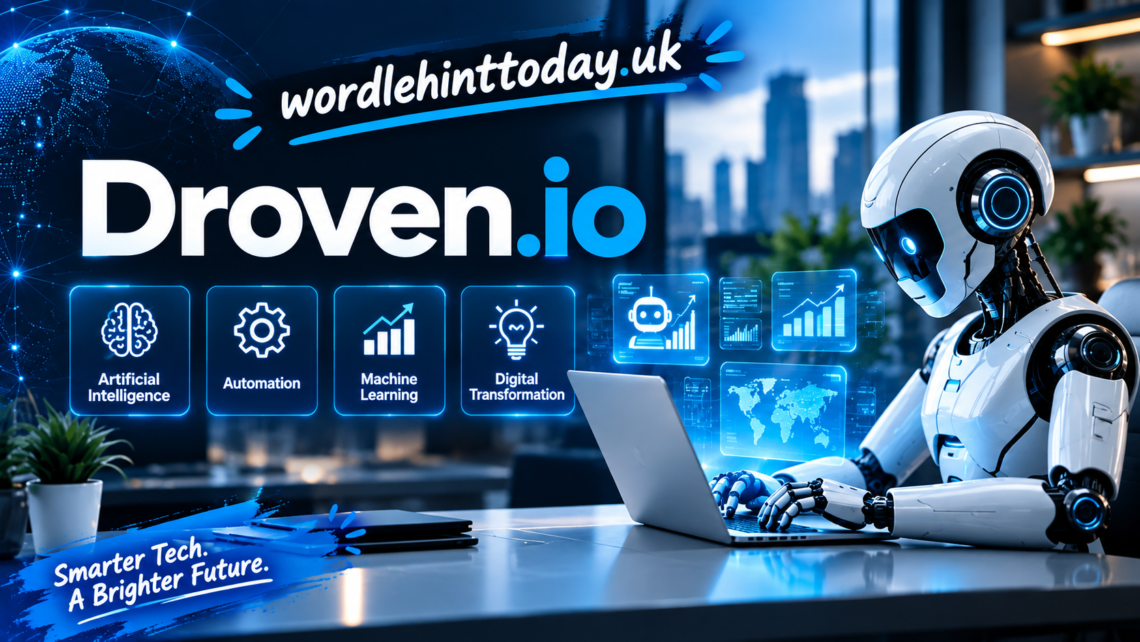
Droven.io is an online editorial hub focused on artificial intelligence, technology, business innovation, and digital transformation. Its public website includes articles covering AI tools, generative AI, business automation, and related technology subjects. This makes it a potential starting point for readers who want to learn about emerging digital trends. <Link url=”https://droven.io/” title=”Visit the official website”/>.
It is important to distinguish an educational website from an AI software product. Reading an article about automation does not mean the website itself provides an automation tool. Based on its publicly presented content, Droven.io functions as a technology publication rather than a dedicated AI application that users operate to automate their own business processes.
Check the Quality of Published Information
When using Droven.io or another technology publication, examine whether an article explains its claims clearly and provides supporting evidence. Reliable educational content should distinguish established facts from predictions, opinions, and promotional statements.
Readers should also check publication dates when researching fast-changing topics. AI tools, software capabilities, pricing, and industry practices can change quickly, so older articles may not reflect current conditions.
Comparing information with official product documentation and other credible sources can provide additional context. This is especially important before spending money or making decisions based on a technology recommendation.
Decide Whether the Resource Meets Your Needs
Droven.io may be useful for discovering topics and building a general understanding of AI and digital transformation. Business owners can explore relevant articles before investigating specific software, while students and technology enthusiasts can use the content to identify subjects for further research.
However, anyone seeking a working AI automation platform should evaluate actual software providers separately. Check available features, pricing, integrations, privacy policies, support options, and cancellation terms before signing up.
The best approach is to use educational resources to understand the available options, then test suitable tools against a clearly defined business requirement. This helps prevent confusion between learning about a technology and purchasing a product that implements it.
Frequently Asked Questions
1. What is Droven.io AI in digital transformation?
Droven.io AI in digital transformation refers to the topic connecting Droven.io’s technology-related content with the use of artificial intelligence to modernize business operations. The website publishes information about AI, automation, and digital innovation. It should not automatically be treated as an AI software product.
2. Is Droven.io an AI automation tool?
Droven.io presents itself as an editorial website covering technology and AI-related subjects. Its articles discuss tools and applications, but that does not establish that the website offers its own automation software. Readers should check its current official pages for any changes in its offerings.
3. How can AI support digital transformation?
AI can help businesses automate repetitive tasks, analyze data, generate content, improve customer support, and identify patterns. Its effectiveness depends on data quality, appropriate implementation, employee training, and human oversight.
4. Who can benefit from reading Droven.io?
Business owners, marketers, developers, students, and technology enthusiasts may find its subject areas relevant. The website’s AI and digital transformation coverage can help readers understand emerging technologies and explore potential business applications.
5. Is Droven.io reliable for AI information?
Droven.io provides technology-related editorial content, but readers should assess individual articles rather than assuming every claim is correct. Check the evidence, publication date, cited sources, and agreement with authoritative documentation before relying on information for important decisions.
Conclusion
Droven.io AI in digital transformation is a relevant topic for readers exploring the relationship between artificial intelligence, modern business practices, and emerging technology. Droven.io’s public website covers AI, generative AI, automation, digital transformation, and related subjects, making it a potential resource for learning about these areas.
The wider value of AI-driven digital transformation comes from solving practical problems. Businesses can use AI to improve workflows, analyze information, support customers, and reduce repetitive work. However, these benefits require thoughtful planning, reliable data, appropriate security measures, and human oversight.
Readers should also understand the difference between a technology publication and a software provider. Droven.io can help introduce relevant concepts, but organizations seeking AI tools should independently evaluate products that match their needs. Ultimately, successful digital transformation depends on choosing appropriate technology, measuring real outcomes, and continuously improving how people and systems work together.