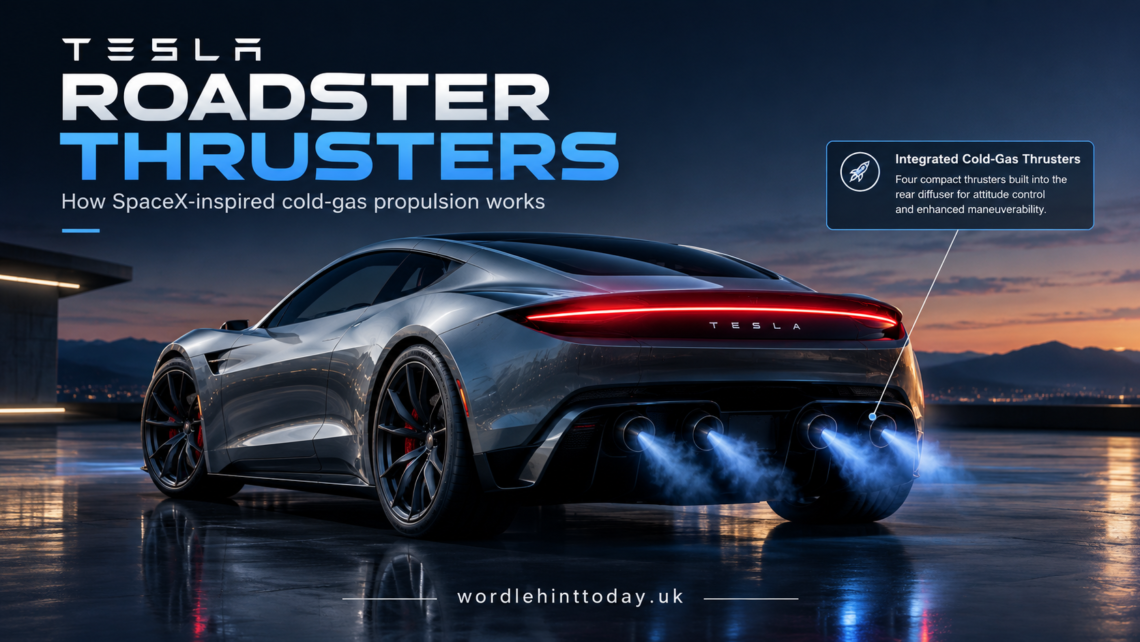
Introduction
The Tesla Roadster thrusters are one of the most unusual features associated with Tesla’s next-generation electric sports car. Unlike traditional performance upgrades, these proposed thrusters could use compressed gas to produce additional force and improve certain aspects of vehicle performance. The concept has attracted attention because it combines electric-car engineering with technology inspired by aerospace systems.
The idea is closely connected to the Tesla Roadster’s proposed SpaceX package. Elon Musk has discussed adding cold-gas thrusters to the vehicle to support extraordinary performance goals. However, the proposed technology should not be confused with a conventional rocket engine or a feature confirmed to be available in a production car.
In this article, we will explain what Tesla Roadster thrusters are, how they could work, why Tesla has explored the concept, and what challenges engineers would need to overcome. We will also examine the expected performance benefits, practical limitations, and important questions buyers should consider before treating these features as established specifications.
Table of Contents
- What Are Tesla Roadster Thrusters?
- How Do the Thrusters Work?
- The Connection Between Tesla and SpaceX
- Potential Performance Benefits
- Engineering Challenges and Safety
- How Thrusters Compare With Traditional Electric Car Technology
- What Buyers Should Know
- Frequently Asked Questions
- Conclusion
What Are Tesla Roadster Thrusters?
Tesla Roadster thrusters refer to a proposed propulsion-assistance system associated with the next-generation Tesla Roadster and its optional SpaceX package. The concept involves using small gas-powered thrusters to generate force outside the vehicle’s conventional electric drivetrain. Instead of relying exclusively on the electric motors that turn the wheels, the car could potentially use controlled gas discharge to produce additional thrust.
Elon Musk publicly discussed the idea of placing cold-gas thrusters in the Roadster’s SpaceX package. These discussions helped establish the concept as one of the vehicle’s most distinctive proposed features. The aim is to explore performance possibilities beyond those offered by ordinary electric sports cars.
It is important to understand the difference between a proposed feature and a confirmed production specification. The thruster concept has received considerable attention, but its final configuration, production readiness, and real-world performance should not be assumed without reliable confirmation from Tesla.
Why Are the Thrusters Different?
Most electric sports cars generate acceleration through electric motors connected to their wheels. The motors produce torque, and the tires transfer that force to the road. This approach is efficient and provides immediate acceleration, but the vehicle remains limited by tire grip, vehicle weight, motor output, and other physical factors.
A thruster system would operate differently. It would expel gas in a controlled direction to create an opposing force. Depending on its design and placement, that force could potentially influence acceleration or other aspects of vehicle movement.
The idea is unusual because it introduces a technology more commonly associated with spacecraft and aerospace experiments into a road-going sports car. However, using a thruster on a car presents very different engineering and safety requirements from using one in space.
How Do the Thrusters Work?
The proposed Tesla Roadster thrusters are associated with cold-gas propulsion. A cold-gas thruster typically releases pressurized gas through a nozzle to generate thrust. Unlike a conventional combustion rocket engine, it does not need to burn fuel inside the nozzle to create its basic propulsion effect.
The system generally consists of a pressurized gas supply, valves, control equipment, and nozzles. When a valve opens, gas escapes at high speed. The reaction force pushes the system in the opposite direction. In a vehicle application, multiple thrusters could be arranged to produce forces in selected directions.
This explanation describes the general principles of cold-gas propulsion, not a verified technical specification for Tesla’s final Roadster system. Public discussions have not established every detail needed to calculate the vehicle’s actual thrust, operating duration, or performance gains.
How Could Thrusters Assist Acceleration?
In theory, a thruster aimed to push the vehicle forward could provide an additional force without relying entirely on the tires to transfer propulsion to the road. This could be particularly interesting during a short acceleration event, when every additional source of force might affect the vehicle’s initial movement.
However, the result would depend on the amount of thrust, its duration, the vehicle’s mass, and the way the system interacts with the rest of the car. A small thruster would not automatically produce a dramatic improvement simply because it uses aerospace technology.
Tire grip would still matter for the forces generated by the electric motors. The suspension, steering, braking system, and electronic controls would also need to manage the vehicle’s response. Thrusters could add another engineering challenge rather than eliminate existing performance limits.
Could the System Control More Than Forward Motion?
A carefully designed arrangement of multiple thrusters could theoretically produce forces in different directions. Aerospace vehicles use directional thrusters for orientation and attitude control, although a car’s needs are substantially different.
For a road vehicle, any additional directional force would have to be predictable and compatible with safe handling. Sudden or uneven thrust could disturb the car’s balance, particularly during cornering or emergency maneuvers.
There is not enough publicly confirmed information to conclude that the Tesla Roadster’s proposed system will provide production-ready directional control or replace conventional vehicle stability systems. Such capabilities should be treated as engineering possibilities rather than guaranteed features.
The Connection Between Tesla and SpaceX
The Tesla Roadster thrusters are linked to the proposed SpaceX package, which draws attention to the relationship between two companies associated with Elon Musk. Tesla focuses on electric vehicles and energy products, while SpaceX develops launch vehicles, spacecraft, and related aerospace technologies.
The SpaceX name is significant because the thruster concept borrows from a field where controlled gas propulsion is already well established. Applying similar principles to a sports car would be an unconventional attempt to explore new approaches to acceleration and vehicle performance.
Nevertheless, the relationship between the two companies does not mean that every SpaceX technology can be transferred directly into a passenger vehicle. Aerospace systems operate under different conditions, and a road car must meet requirements involving passengers, pedestrians, road surfaces, maintenance, and everyday reliability.
What Is the SpaceX Package?
The SpaceX package has been discussed as an optional performance-oriented configuration for the next-generation Roadster. Public statements have associated it with cold-gas thrusters intended to push the car’s performance beyond conventional electric sports-car capabilities.
The precise production design, availability, and final technical details require confirmation from Tesla. Buyers should therefore avoid treating every description circulating online as an official specification.
An optional package would also be different from the standard vehicle. Even if Tesla eventually offers a thruster-equipped version, its equipment, operating requirements, cost, and approved use could differ from those of a regular Roadster.
Why Has the Idea Attracted So Much Attention?
Electric cars have already changed expectations about acceleration. Electric motors can deliver torque quickly, and sophisticated control systems can coordinate power delivery across the vehicle. A thruster-equipped Roadster would represent a more radical departure from the usual approach.
The idea also combines two recognizable areas of technology: high-performance electric vehicles and aerospace propulsion. That combination naturally attracts interest from car enthusiasts, engineers, and people following future transportation concepts.
Still, an exciting concept is not the same as a proven product. Its long-term importance will depend on whether the technology can deliver measurable benefits while remaining safe, practical, and suitable for everyday ownership.