Introduction to Perpendicular Lines:
Perpendicular lines might sound like a simple middle-school geometry topic, but once you really dig into them, you realize they quietly power a huge portion of the world around us. From the corners of your room to city streets, engineering blueprints, and computer graphics, perpendicular lines show up everywhere. They are one of those foundational ideas that seem basic at first, yet they hold together entire systems of mathematics and design.
In this guide, we are going to explore perpendicular lines in depth. Not just definitions, but intuition, real-life applications, problem-solving strategies, coordinate geometry connections, proofs, constructions, and even how professionals use them in architecture and technology. The tone will stay casual and approachable, but the explanations will carry the precision you would expect from an expert.
Let’s break it down step by step and truly master the concept of perpendicular lines.
What Are Perpendicular Lines? Understanding the Core Concept
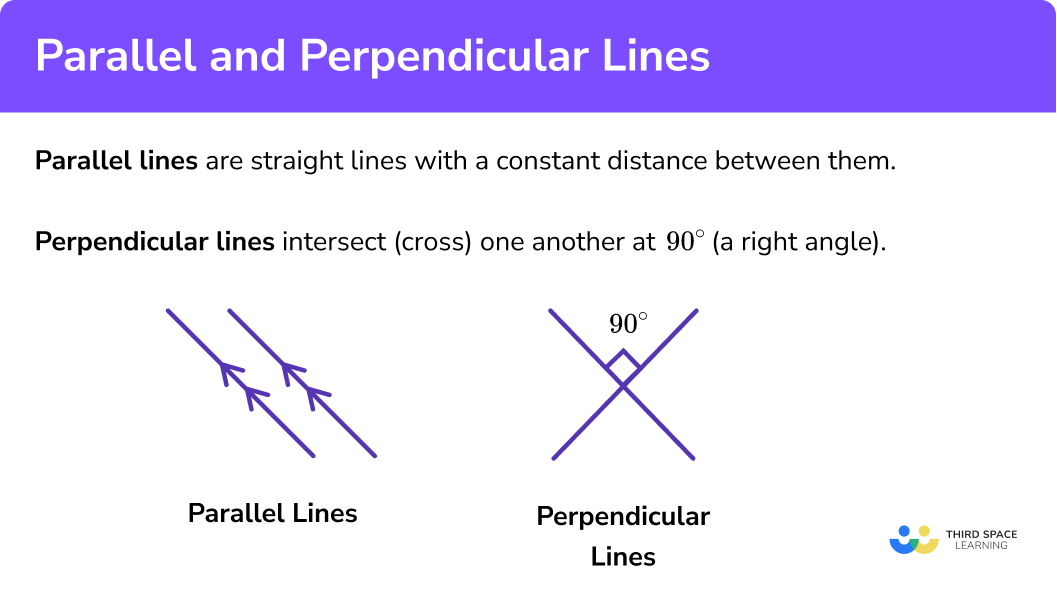
Perpendicular lines are two lines that intersect and form a right angle, which measures exactly 90 degrees. That’s the textbook definition, but it helps to visualize it more naturally. Imagine the corner of a book or the edge where a wall meets the floor. Those edges meet at a perfect “L” shape. That shape is the visual fingerprint of perpendicularity.
When two lines meet at 90 degrees, they create four equal angles around the intersection point. Each of those angles is 90 degrees, and together they sum to 360 degrees, completing a full rotation. This symmetry is important because it makes perpendicular lines incredibly stable and predictable. In mathematics, predictability is gold, and that is one reason perpendicular relationships appear so often.
We usually represent perpendicular lines with a small square at the angle or by using the symbol ⟂. For example, if line AB is perpendicular to line CD, we write AB ⟂ CD. This notation is compact but powerful because it instantly tells you something very specific about the angle between the lines. From that single symbol, you know measurements, slopes, and even geometric properties that follow automatically.
Why Perpendicular Lines Matter in Everyday Life
At first glance, perpendicular lines feel like an abstract classroom topic, but they are actually everywhere around us. Look around your room. The walls meet the floor at right angles. Doors, windows, tables, and bookshelves rely on perpendicular edges for strength and balance. Without these right angles, structures would look skewed and feel unstable.
Architecture and construction depend heavily on perpendicular lines. Builders use tools like carpenter’s squares and laser levels specifically to ensure that beams and walls meet at 90 degrees. If they didn’t, buildings would lean, doors wouldn’t close properly, and floors wouldn’t be level. The simple right angle is what keeps structures safe and functional.
Even city planning uses perpendicular designs. Many cities follow grid layouts where streets intersect at right angles. This makes navigation easier, simplifies land division, and improves traffic organization. So while perpendicular lines might start as a math concept, they quickly become a practical necessity for the real world.
The Geometry Behind Right Angles
Now let’s dig a little deeper into the mathematics. In geometry, angles are measured in degrees, and a right angle is exactly 90 degrees. Perpendicular lines are defined entirely by this measurement. No matter how long or short the lines are, or where they sit on the plane, the 90-degree relationship is what makes them perpendicular.
One interesting property is that when two lines are perpendicular, all adjacent angles form complementary pairs. That means any two angles that share a side add up to 90 degrees. This consistency helps when solving geometry problems because once you know one angle, you instantly know the others. Geometry becomes less about guessing and more about logical deduction.
Another useful fact is that perpendicular lines often create congruent triangles and symmetrical shapes. Because right angles are so structured, they simplify proofs and calculations. That’s why so many theorems, especially in triangles and coordinate geometry, depend on perpendicular relationships. They provide a reliable framework that mathematicians can build on.
Perpendicular Lines in Coordinate Geometry
Things get even more interesting when we move to coordinate geometry. Here, lines are represented by equations instead of drawings. The key concept becomes slope, which measures how steep a line is. The slope tells us how much the line rises or falls as it moves horizontally.
For perpendicular lines, there is a special relationship between their slopes. If one line has slope m, the slope of a perpendicular line is the negative reciprocal, written as −1/m. For example, if one line has slope 2, a perpendicular line has slope −1/2. This rule works every time, and it gives you a fast algebraic way to identify or construct perpendicular lines.
This slope relationship is incredibly powerful. It allows you to test perpendicularity without measuring angles. Instead of using a protractor, you just check the slopes. Engineers, programmers, and data scientists use this principle constantly. It transforms a geometric idea into a simple numerical calculation, which is much faster and more precise.
Constructing Perpendicular Lines: Tools and Techniques
Constructing perpendicular lines is a classic geometric skill. Traditionally, you use a ruler and a compass. By drawing arcs from a point and creating equal distances, you can locate a line that forms a perfect 90-degree angle. It might feel old-school, but this method is extremely accurate and still taught because it builds strong geometric intuition.
In modern classrooms and workplaces, tools like set squares and protractors make the process easier. You simply align the right angle of the tool with your existing line and draw along the edge. This is faster and very practical, especially when drafting or sketching diagrams by hand.
Digital tools have taken it even further. Software like CAD programs and graphic design platforms automatically snap lines into perpendicular positions. With one click, you can guarantee a perfect right angle. Even though the computer does the work, the underlying mathematics is still the same principle that has existed for centuries.
Applications in Advanced Mathematics and Science
Perpendicular lines don’t stop at basic geometry. They appear throughout higher mathematics and science. In vector algebra, perpendicular vectors are called orthogonal vectors. When two vectors are orthogonal, their dot product equals zero. This property is crucial in physics, engineering, and computer graphics.
In physics, perpendicular directions often represent independent forces or motions. For example, horizontal and vertical movements are treated separately because they are perpendicular. This separation simplifies calculations and makes complex problems easier to manage. Without perpendicular axes, analyzing motion would become messy and confusing.
Computer graphics also rely heavily on perpendicular coordinate systems. Screens use x- and y-axes that meet at right angles. Every image, animation, and video game you see is built using this perpendicular framework. So even modern technology quietly depends on the same right angles you first learned about in school.
Problem Solving and Mastery: Thinking Like an Expert
To truly master perpendicular lines, you need more than memorizing definitions. You should start recognizing patterns. Whenever you see a square corner, a cross shape, or a slope that looks like a negative reciprocal, your brain should immediately suspect perpendicularity. This habit turns geometry from guesswork into structured reasoning.
Practice also matters. Try sketching figures, finding slopes, and verifying right angles using algebra. The more problems you solve, the faster your intuition develops. Eventually, you won’t even need formulas because you’ll instinctively know when lines must be perpendicular based on the situation.
Most importantly, think about the concept beyond math problems. Notice it in buildings, streets, furniture, and digital designs. Once you start seeing perpendicular lines in everyday life, the idea sticks permanently. That’s when you know you’ve moved from memorization to true understanding.
Conclusion:
Perpendicular lines might begin as a simple definition—two lines that meet at 90 degrees—but they grow into something much bigger. They form the backbone of geometry, provide structure in architecture, simplify algebra in coordinate systems, and support modern technology in ways most people never notice. Few mathematical ideas are as small in wording yet as large in impact.
What makes them so special is their reliability. Right angles create order. They bring symmetry, stability, and clarity. Whether you’re solving a triangle, designing a house, or coding a video game, perpendicular relationships give you a dependable framework to work within. That’s why this concept keeps appearing across so many disciplines.
So the next time you see the corner of a table or a street intersection, remember that you’re looking at perpendicular lines in action. It’s a simple idea, but it quietly holds the world together—one right angle at a time.